Free shipping to the put-in · 90-day guarantee · Molded in Orange, California
The Canoe Cup Holder.com

Finally, somewhere to put your drink in the canoe.

4.9 from 119 Steadi reviews

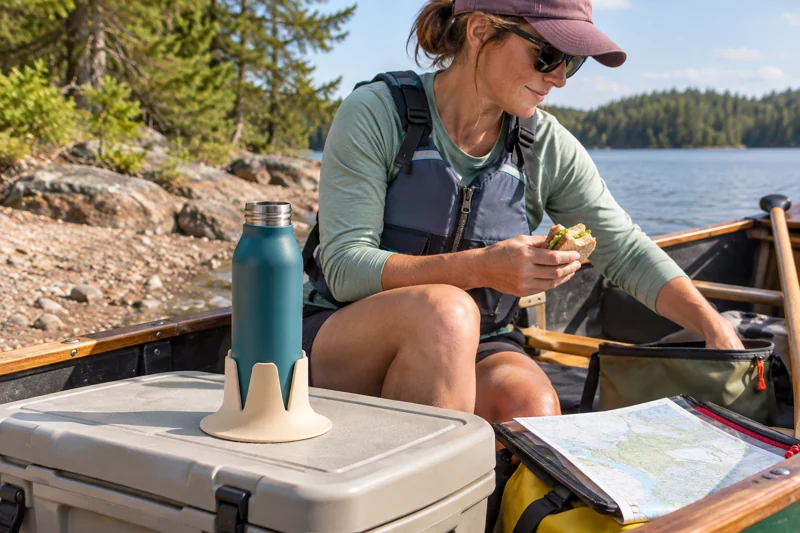
A flexible-finned base that holds your coffee, water bottle, or tumbler steady on the floor of the hull — through strokes, wakes, and the lunch stop with a rod in your other hand. One honest note: it doesn't float, so keep it out of the lake itself — everything else about a wet boat, it shrugs off.

Get one for the bow, one for the stern — from $14.95

Free shipping to the put-in — 90 days to prove it in your own boat, no forms if it doesn't earn its spot.

Will your bottle fit in the hull? A sticky note answers it — the test is below ↓

Prefer the maker's own store? steadilabs.com →

Left to right: the wide, low base empty, then holding a cup, a can, and a large tumbler.
One base, bow to stern. Empty, then a cup, a can, and the 40-oz tumbler — same base that rides the bilge floor between strokes.

The moments

Ask any paddler. They've already lived this trip.

First light, the dawn coffee paddle

Thermos poured at the put-in while the mist is still sitting on the water. One crosswind lean is all it takes — the cup wedged between your feet tips over and rolls down the bilge, chasing the drip already coming off the paddle shaft.

Mid-lake, when somebody's wake rolls through

A fishing boat idles past and its wake catches the hull broadside — a few seconds of rocking is all it takes, and everything standing upright goes over together. The bottle rolls toward whoever's paddling stern, and neither of you can let go of a stroke to grab it.

The portage landing

The hull scrapes up onto the gravel and both hands go straight to a pack and the yoke. The bottle you set down at your feet finds the gap under the seat frame right as the carry begins — and the coffee you'd been saving for this exact break is what ends up sideways.

The fishing drift, rod in hand

Coffee balanced on the cooler lid, one hand free and the other on the rod. A strike hits and the drink gets abandoned wherever it's standing — right as the lid underneath it becomes the thing you need open for bait.

Loading at the put-in

Bottles balanced on the inch-wide gunwale or a wet rock at the shoreline while the packs get sorted and trimmed. One bump of the hull and it's over the side — and out here, whatever goes under stays under.

Where things stand

A canoe hands you a paddle and a yoke, and no flat place for a drink.

Open a canoe and count the flat spots: none. Every rail is round, every seat is occupied, and the one wide surface amidships is a cooler lid or a pack that comes off the boat at every portage. Whatever you set a drink on, you're improvising it.

The bilge, which is never dry.

Paddle shafts wear rubber drip rings for a reason — water comes off the blade with every stroke and pools at the lowest point of the hull, right between the paddlers' feet. Set a drink there and it stands in gritty water until the next lean tips it over.

Wedged beside or under the seat.

The free option, and the default one. Paddlers report the wedge working loose the moment the water gets choppy, and if you kneel to paddle, the foot slot it was hiding in disappears entirely.

The gunwale, for just a second.

The inch-wide top rail makes a fine shelf for exactly as long as the hull holds still. One bump at the landing sends whatever was balanced there into the lake — and it sits directly in the path of every paddle stroke besides.

Both hands are already busy.

There's no free hand for a drink underway — the paddle takes both, stroke after stroke. Trippers describe saving the thermos for portage breaks instead of drinking on the move, which defeats half the reason for bringing coffee at all.

No holder built in, anywhere.

No console, no molded recess, no dash — canoes don't have any of it, unlike the sit-on-top kayaks that mold one in standard. Every drink placement on this boat is something a paddler invents on the spot, trip after trip.

It's not a crisis on the water. It's a hull with nowhere flat, and every trip you quietly reinvent the same workaround.

What's in it

Three reasons it earns a spot in the hull.

01

Made for a floor that's never flat or dry.

The wide, low base spreads across the hull's curve instead of standing on a single point of it, so it doesn't roll to the centerline with every lean. Paddle drip and bilge water pool around it, not into what you're drinking.

02

One base for the thermos, the can, and the tumbler.

Cans and bottles slide straight on; cups and the travel mug (no handle) drop in through the fins and get gripped by the bottom inch. Whatever's riding in the cooler that morning, it's the same base underneath it.

03

Comes off the floor before the next portage.

One piece of flexible material, nothing clamped to the gunwale or bolted through the hull. It lifts off in a second, rides flat in a pack for the carry, and goes back down at the next put-in.

The desk-drawer test

The fit test packs flatter than a map.

your cup's base
lands in here

A square sticky note: 3 inches, exactly — same as the ceiling of what fits in the boat.

01
Grab a sticky note.

The standard square sticky note measures exactly 3 inches on a side — a fact about sticky notes, and also the exact ceiling of what the base will grip.

02
Stand the bottle or cup on it, right at the put-in.

Base down, not the rim — bottle shoulders bulge and cups flare, but the bottom is the only measurement that decides the fit. Test it before you're relying on the answer mid-lake.

03
Read the note.

Base sits inside the square? It fits. Hangs over the edge — like the wide-mouth Nalgene does? Too wide. A tiny puck lost in the middle, under 2 inches? Too narrow.

No calipers at the landing, no guessing at the outfitter — one sticky note, one glance, with the bottle you're actually bringing on the trip.

Sizing it up

The bottom inch decides what makes the trip.

One number decides most of this list: a base of 2 to 3 inches settles in, floor and ceiling both. Everything below runs off that line — including the one trip staple that comes in wide.

  • Stanley 40 oz H2.0 FlowState Quencher fits
  • 32-oz wide-mouth Nalgene too wide
  • Quart stainless bullet thermos fits
  • 16-20 oz travel mug, no handle fits
  • Enamel camp mug, handled handle in the way
  • 12-oz can in a foam koozie fits
  • 1-liter disposable water bottle fits
  • Collapsible soft flask (Platypus-style) no base to grip

Go narrower than 2 inches and there's not enough base for the fins to close around. The Nalgene misses on the other end — its base runs wider than the range by about half an inch. And the enamel camp mug is the familiar exception: the base itself fits fine, but the handle sits exactly where a fin needs to close.

The full fit database — Stanley, Red Bull, Yeti, and 30 more, with sourced base measurements →

The trick, explained

Built for a hull that heels with every stroke.

It lies across the arch, not on top of it.

A canoe floor is a shallow curve, not a flat deck — anything narrow tips toward the centerline. The base is wide enough to bridge that arch instead of balancing on one point of it.

Fins close around the bottom inch.

Flexible fins hold the container by its bottom inch from all sides, so paddle drip, a bumped knee, or a passing wake can't roll it loose.

The hull moves. The base moves with it.

A lean into a stroke, a wake rolling under the hull, a shift to trim the boat — the low, wide base rocks with the tilt instead of staying rigid against it, and the drink comes back level.

No jaws, no bolts, nothing to fit to your rail. It doesn't clamp to the gunwale, bolt through the hull, or depend on your boat's rail being a certain width or shape. It sits loose in the bilge or on the floor between your feet, works on any hull, and comes out in a pack for the carry — not strapped around your neck at the yoke.

The alternatives

What paddlers already strap on — and take back off.

A clamp-on gunwale cup holderThe Canoe Cup Holder
Where it rides on the hullClamped to the rail, in the paddle's pathLow in the bilge, out of the stroke
Fitting your boat's gunwaleJaws sized to one rail's width and materialNo rail to match — just floor to sit on
Floor spaceMounted on the rail — none takenDown in the bilge — small, but real
At the portage landingUnclamped before the carry, clamped back afterLifts off in a second, packs flat
When the water gets choppyA loose fit rattles and spills, reviewers sayFins close around the base and settle in
Moves boat to boatStays clamped to the one rail it fitsPacks flat, goes to whichever hull's out
CostA separate purchase, sized to one boatOne small piece, easy to justify
Clamp-on gunwale cup holders

Scotty-style clamps and their imitators depend on jaws that match your gunwale's width and shape — reviewers report jaws too narrow for their rail, or a fit so loose the holder rattles and spills on its own. And it still has to come off the hull for every portage and car-top.

Suction-cup drink holders

Forum consensus is blunt: cheap suction cups don't hold and don't last. One paddler reported his dropping off daily; another re-wetting it with dish soap weekly just to keep it stuck. A canoe's textured, curved, gritty interior is close to the worst surface suction was ever asked to grip.

Thwart bags with a bottle pocket

The pocket runs too small for anything but a slim bottle, and the bag itself swings against your knees underway. Multi-portage trippers describe tolerating it for one carry and leaving it home after that — one more thing to strap on and off at every landing.

Recessed or track-mounted holders

Recessing one means cutting into the hull — gear roundups themselves flag the leak-and-warranty risk — and gear tracks are a fishing-kayak fitting, not something wood-gunwale or rental canoes come with.

From the reviews

What buyers say.

Recent reviews of the Steadi, from every room and rig it lives in.

★★★★★

I have a tendency to spill my drinks and have two cats. This is one of the best things I’ve ever impulse bought. It works. It actually works. It’s a heavy, wide enough base that it is actually stable. My “spot” in the living room is near a somewhat-cushioned fabric ottoman, which is where I usually put my drinks. It’s

Dixie · 2026-08-30
★★★★★

I love mine. I just wish the price was more appropriate. $15 seems a lot for a small plastic item. Reduce it to $9.99 and free shipping and I'll buy a few more!

Carolyn G. · 2026-08-27
★★★★★

Excellent!

Brian S. · 2026-08-27
★★★★★

Thank you for your service!

Brian S. · 2026-08-27
★★★★★

It’s great love it

gilbert a. · 2026-08-24
★★★★★

I never knock over my water at night anymore!

Customer · 2026-08-21

Read all 119 reviews →

All 119 reviews are for the drink base itself, collected across every place people use it.

Fair questions

You're probably thinking…

“This is just going to be another suction-cup holder that quits on me in a week.”

No suction, no adhesive — fins grip the container's base and the wide pad bridges the hull's curve instead of trying to stick to it. That's the specific suction failure mode this design skips entirely.

“If it goes over the side, I've lost it in the lake for good.”

Told straight, up front: it doesn't float, so treat it like your keys and keep it low in the boat. Bilge water, rain, a splash over the side — all fine. It's only the open lake itself that's a one-way trip.

“My Nalgene or my big tumbler probably won't fit anyway.”

The sticky-note test settles it in one glance with the bottle you're actually bringing — and the page says plainly that the 32-oz wide-mouth Nalgene is the one honest miss, so you're not left guessing.

“I've made do wedging it under the seat for years — do I really need this?”

The wedge only works until the water gets choppy or you switch to kneeling, and this costs less than a bag of trip coffee — low enough stakes to just find out.

“It's one more thing to strap on and off at every portage.”

Nothing straps on in the first place — it lifts off the floor in one motion and packs flat in a pack pocket, no clamps to unclamp.

Why more than one

Two paddlers. Two thermoses. Whose is whose?

Bow and stern each pack their own tumbler at the put-in, and by the lunch stop both have rolled to the same low spot in the bilge. Identical steel, identical caps — the only difference was who filled it that morning, and that detail doesn't survive a portage.

Build your set

Give everyone their own.

Pick a pack, then give each one a color — so nobody has to ask which drink is theirs.

Details

Asked at the put-in, answered here.

Does it float, or does it sink if it goes in the water?

It sinks — plainly, no float built in. Soaking it in bilge water, rain, or a splash over the side is completely fine, and it rinses clean. But if it goes over the gunwale into the lake itself, treat it like your keys: gone. Keep it low in the boat and you likely never have to think about it again.

Does it actually work on a curved hull, not just flat surfaces?

Yes — that's specifically what the wide base is for. It bridges the arch of the hull floor instead of resting on one point of the curve, and the fins keep a cup from migrating toward the centerline as the boat rocks. Tip the hull and the base holds the drink again on its own.

How do I know if my cup or bottle will fit?

Stand it up and look at the bottom, not the rim — tumblers taper and bottle necks narrow, so the base is the only measurement that matters. Anywhere from 2 to 3 inches across settles in; the 40-oz Stanley is on the fitting end of that range.

Will my Nalgene fit?

The 32-oz wide-mouth is the one honest miss — its base runs about 3.5 inches, wider than the 2-to-3-inch range that settles in. A narrower bottle, a can, or the 40-oz Stanley all fit; the wide-mouth Nalgene is the trip staple that doesn't.

What about my thermos, or a travel mug without a handle?

Most bottle-shaped thermoses fit inside the range. A travel mug works too as long as it doesn't have a handle — handled versions run into the same problem enamel camp mugs do: the base fits, but the handle sits where a fin needs to grip.

Does it clamp to the gunwale or a thwart?

Nothing clamps, bolts, or ties to the hull — it isn't that kind of holder. It rests loose on the floor of the boat, so there's no jaws to size to your rail and nothing to strip off before the portage.

I paddle rough water and boat wakes — will it actually hold?

Movement is the normal condition here, not the exception. The low, wide base rocks with each tilt and brings the drink back level as the boat rocks through a wake. A paddle stroke or a passing wake, it settles back from; a direct hit from a gunwale bump is a harder ask, same as it would be for anything else riding loose in the boat.

Is it BWCA-legal?

The Boundary Waters bans cans and glass bottles for food and drink — that's a rule about what you pour into, not what holds it. The base isn't a container, so it works the same everywhere in the wilderness; bring your drinks the way BWCA already requires and set them in the base as usual.

How do I get the bilge grit out of it after a trip?

Dunk it and swirl it in the lake before you load the car, or wipe it down once you're home, or put it in the dishwasher. It's a single piece of solid flexible material — no seams, no hinges, nowhere for sand or grit to hide.

Who makes it, and where do I buy one?

The base is called the Steadi. It's molded in small runs in Orange, California by Steadi Labs — veteran-founded, patent pending — and it ships free from steadilabs.com, with 90 days to decide it's earned a permanent spot in the boat.

All 18 questions, answered →

Ninety days of real trips.

Paddle with it for a month. If it doesn't do what this page says — in the bilge, on the cooler lid, at the landing — email hello@steadilabs.com and it gets made right. No forms, no fight.

Veteran-founded · Patent pending · Made in Orange, California

The company

Molded a short drive from the water.

The maker is Steadi Labs, a small veteran-founded company in Orange, California. It's injection molded in small runs, and nothing about it travels far — the mold, the material, and the color runs all sit within about three and a half miles of the shop, a shorter carry than most portages. The people who make it read hello@steadilabs.com themselves, same as they'd answer you at the put-in.

Keep both hands on the paddle.

The drink stands in the bilge between your feet, on the cooler lid at lunch, at the portage landing — steady on every surface the boat has, and out of the water where it doesn't belong.

Add it to the pack list — ships free

Checkout happens on steadilabs.com — Steadi Labs is the company that makes it.